

Last updated: September 30, 2026. USCIS policy changes without notice. This page describes the rules as of the date above.
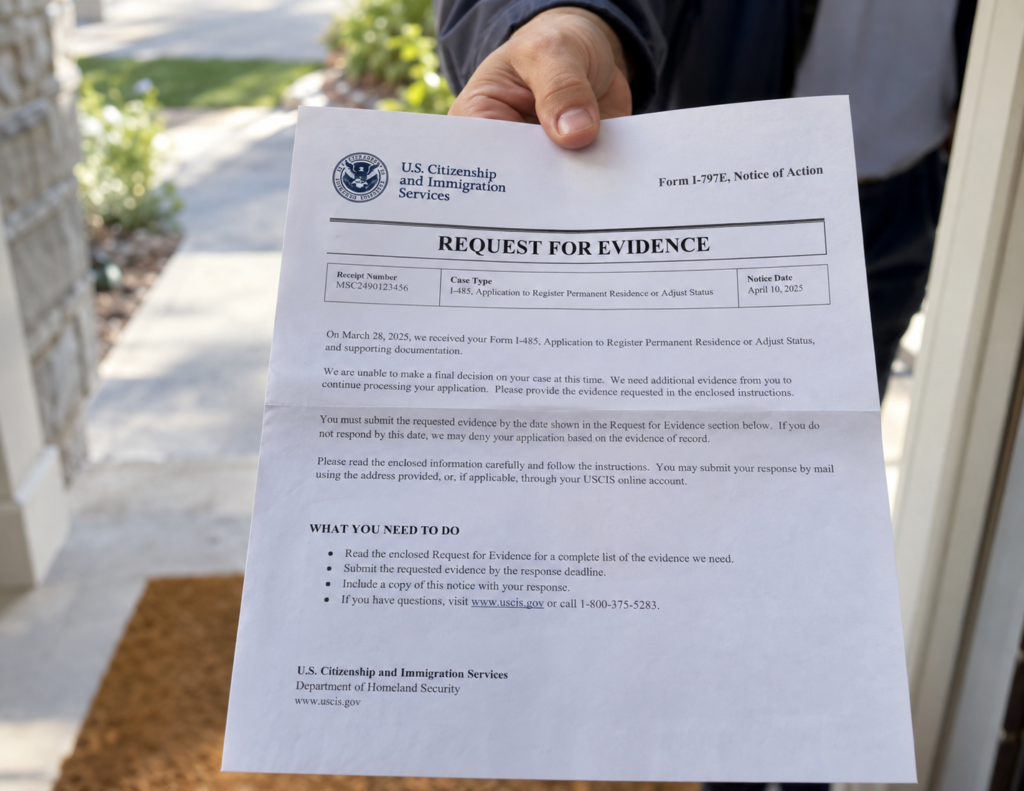
If you just opened a letter from USCIS, you may feel scared. You may also be short on time. This page tells you what the letter means, how long you have to act, and what to send.
Two things changed on August 5, 2026. USCIS can now deny a case without warning you first. Response times are shorter too. The next few weeks matter more than they used to.
In short
- USCIS can deny your case without sending an RFE or a NOID first. This started on August 5, 2026.
- An RFE gives you up to 12 weeks to answer. But USCIS does not have to give you that long. Many people now get 30 days.
- A NOID gives you up to 30 days. You cannot get more time.
- If you send only part of what USCIS asked for, USCIS can decide your case right away.
- These rules apply to cases you already filed, not just new ones.
What an USCIS RFE is and why you got one
RFE (Request for Evidence). USCIS wants more proof before it decides your case. An RFE is not a denial. It means your case is still open. The letter tells you what USCIS wants and when to send it.
NOID (Notice of Intent to Deny). USCIS plans to deny your case. You get one chance to change its mind. You have 30 days or less to answer.
RFIE (Request for Initial Evidence). The same idea as an RFE, but for documents that should have been sent with your application in the first place.
Denial. USCIS said no. You may still have options. The options depend on the reason in the letter.
What changed on August 5, 2026
On that date, USCIS issued a policy alert called PA-2026-05. It changed the rules officers follow when a case is missing documents.
Before August 5, officers were told to send an RFE or a NOID first. That gave people a second chance. USCIS now says that practice let people file weak or empty applications on purpose. The agency says some people filed a bare application just to get a receipt, and with it a work permit, while the case sat in line.
The new policy gives officers the choice to deny right away instead. USCIS calls this “restoring” a power that the rules always gave it.
So the old safety net still exists. You just cannot count on it.
How to respond to a USCIS RFE: what to do first
Read the whole letter today. Do not skim it. It lists each document USCIS wants.
Then check the deadline. Find the date printed on the notice. Count from that date, not from the day the mail arrived. Do not count from the day you opened it.
Then check what kind of RFE you have. Some ask for one document, like a medical exam. Others ask for many things.
Put the deadline in your calendar. Set a reminder two weeks before it too.
How long do you have to answer a USCIS RFE?
The rule is simple, but people get it wrong.
- An RFE can give you up to 12 weeks. It cannot give you more.
- A NOID gives you up to 30 days. It cannot give you more.
- If USCIS mails the notice, you get 3 extra days.
- You cannot ask for more time. The law does not allow it.
One more change matters here. USCIS used to add 14 extra days for notices mailed outside the United States. That is gone. If you live abroad, count only the 3 mail days.
USCIS also used to give most people the full 12 weeks. Officers no longer have to. Across the country, people are now getting RFEs with 30-day deadlines.
Treat the date on the letter as final. It is.
What happens if you send a partial USCIS RFE response
USCIS treats any reply as a request to decide your case. That includes a reply that answers only part of the letter.
So if you send two of the four documents, you may hand the officer enough to deny your case. Officers do not have to wait for the rest.
What should you do instead? Send your response when the file is complete, or almost complete. If one document cannot be found in time, say so in your cover letter. Name the document and explain what you are doing to get it.
Be honest with yourself about that plan. A cover letter does not buy you more time. It only helps the officer understand your file.
I got a denial. What are my options?
First, read the reason. A denial for a missing paper, a denial for not qualifying, and a denial for missing your deadline are three different problems. Each has a different fix.
You may be able to file a motion to reopen or reconsider. You have 30 days from the date of the decision. Reconsideration means USCIS made a mistake with the law or the file. Reopening means you have new facts or new proof.
Some denials can be appealed. You file Form I-290B. Not every denial can be appealed. It depends on the form and the office that said no.
You may also be able to file again. That is sometimes faster. But check the costs first. Priority dates do not carry over from a case you withdrew or abandoned. A denial can also affect how much time you have spent in the United States without status, and the work permit that came with your pending case.
You have 30 days. Call a lawyer the day the denial arrives.
Can USCIS deny my case without asking me for anything?
Yes, for most application types. This has always been allowed by the rules at 8 CFR 103.2. The agency stopped telling officers to send an RFE first.
Know two limits.
First, some cases are run under different rules. Asylum and refugee cases are the main example. They follow their own set of rules for requests, denials, and missed appointments.
Second, a NOID still exists. When you send all the required documents but they do not prove your case, an officer can send a NOID instead of denying outright. That gives you a chance to answer.
What counts as proof?
USCIS ranks evidence in three levels. Send the strongest level you can get.
1. Original documents. These are papers made when the event happened. A birth certificate. A marriage certificate. A divorce decree. A court order. Your I-94. An approval notice. Tax returns.
2. Substitutes. Use these when the original cannot be found or does not exist. You must prove you tried. A letter from the government office that holds the record works well. The letter should say the record is missing and why.
3. Sworn letters from people who know you. USCIS calls these affidavits. They come last. Use them only when levels 1 and 2 are not possible. USCIS treats them as a statement of the facts, not as proof the facts are true.
Two warnings. A letter from your mother is easy to write and easy for an officer to discount. And saying “I could not find the document” means little if you have no proof that you looked.
How to build a response that works
- Print the list of documents from the RFE. Check off each item as you get it.
- Send originals or certified copies when you can. Never send your only original unless the instructions say to.
- Translate every document that is not in English. Include a signed statement from the translator.
- Write a cover letter. List each item USCIS asked for and the document you sent. Use a table if you can. An officer should be able to approve your case from the cover letter alone.
- Check the form number, the edition date, and the fee. The wrong form or fee creates a new problem.
- Sign every form. Fill every required box. Blank boxes cause denials.
- Make a full copy of everything before you mail it. Send it so you get proof of delivery.
- Ask one question before you mail it: if an officer read only this package, would she approve it? If the answer is no, do not mail it yet.
Which cases get denied fastest
The cases at risk share one trait. They were put together assuming an RFE would come.
- Green card applications missing birth certificates, marriage certificates, or the affidavit of support.
- Family petitions with thin proof of a real relationship.
- Work permit and travel document applications missing proof of the category.
- Employer petitions missing company records or proof of the job duties.
- Citizenship applications with gaps in the years USCIS checks.
Yes. Since August 5, 2026, an officer can deny your case without an RFE or a NOID. This can happen if you did not send the required documents with your application. It can also happen if your documents do not prove you qualify.
Up to 12 weeks, but USCIS does not have to give you that long. Many RFEs now give 30 days. Count from the date on the notice. You cannot get an extension.
An RFE is not a denial. It means USCIS is still working on your case and needs more information. That is better than a denial, but the clock is now running.
No. Many cases are approved after an RFE. The result depends on what you send back and how fast you send it.
USCIS will likely deny your case. You may still be able to file a motion to reopen or reconsider within 30 days of that denial, or file again. Call a lawyer as soon as you know you are late.
No. An RFE asks for proof. A NOID says USCIS plans to deny. A NOID is more serious and gives you 30 days or less.
Sometimes. If you filed your case online, your USCIS account may let you upload the documents. Many RFEs still require mail. Follow the instructions printed in your notice.
Check your case status in your USCIS online account. Save your mailing receipt and tracking number. If the status does not change in a few weeks, call USCIS.
It varies. Some cases get a decision in weeks. Others take months. Premium processing cases follow their own timelines.
Sometimes. It depends on the form and the office that denied your case. Many denials can be answered with a motion to reopen or reconsider instead of an appeal. You have 30 days from the decision.
Often yes. Before you do, find out what happens to your priority date, your work permit, and your time in the United States without status. Filing again is not always the cheapest answer.
Not always. Simple RFEs, like a request for a new medical exam, are often handled alone. But you cannot extend the deadline, and a denial costs more than help does. A short review of your RFE is worth it when your case is complex or your future here is on the line.
That is allowed under the August 2026 policy. Read the denial to see the reason. If USCIS denied your case for a missing document, a motion to reopen or reconsider is often the fastest fix.
Talk to us
If you received an RFE or a denial, do not wait. Deadlines here cannot be extended.
Legacy Immigration, LLC works on immigration cases only. Attorney Dawn C. Sequeira has practiced immigration law since 2008 and handles family petitions, green cards, work permits, citizenship, and denials. Our office is in Bethesda, Maryland, and we help clients in DC, Maryland, and Virginia.
Call our office or book a consultation. Bring your notice and the letter you received. We will tell you what the deadline is, what USCIS wants, and what your options are.
Legal Disclaimer
The information provided in this article is for general informational and educational purposes only and should not be construed as legal advice. Reading this article, submitting a contact form, or communicating with us through this website does not create an attorney-client relationship between you and Legacy Immigration.
Immigration law is complex, dynamic, and highly dependent on specific individual circumstances. You should not act, or refrain from acting, based on any information contained in this article without seeking professional legal counsel from a licensed immigration attorney qualified in your jurisdiction. Legacy Immigration expressly disclaims all liability with respect to actions taken or not taken based on any or all contents of this article.
Sources
- USCIS newsroom alert, “USCIS to Reduce Frivolous Immigration Benefits Requests by Reinforcing Evidence Standards,” August 5, 2026. https://www.uscis.gov/newsroom/alerts/uscis-to-reduce-frivolous-immigration-benefits-requests-by-reinforcing-evidence-standards
- USCIS Policy Alert PA-2026-05, “Evidence, Requests for Evidence, and Notices of Intent to Deny,” August 5, 2026. https://www.uscis.gov/sites/default/files/document/policy-manual-updates/20260805-EvidentiaryStandards.pdf
- USCIS Policy Manual, Volume 1, Part E, Chapter 6 (Evidence). https://www.uscis.gov/policy-manual/volume-1-part-e-chapter-6
- 8 CFR 103.2. https://www.ecfr.gov/current/title-8/section-103.2
- 8 CFR 103.5. https://www.ecfr.gov/current/title-8/section-103.5
- Immigration and Nationality Act section 291.